News Flash: Nvidia Discusses Boosting Reflection Investment & Top 3 Architect Dispatches?
1. Nvidia Eyes Acquisition of Reflection AI to Bolster Agentic Workflows
The News Highlight:
Nvidia is reportedly in early-stage discussions to significantly increase its investment in or potentially acquire Reflection AI, a startup that recently made waves with the debut of its open-weight model, Beam. This move signals Nvidia's aggressive push to move beyond hardware dominance and into the software layer that powers autonomous AI agents. Reflection AI’s Beam model is specifically engineered to provide high performance for coding and agentic tasks at a lower price point than proprietary giants, making it an attractive asset for Nvidia’s ecosystem.
- Strategic Investment: Nvidia is exploring options ranging from providing massive computing power to a full acquisition of the startup.
- Beam Model Architecture: Reflection AI’s flagship model, Beam, is an open-weight release optimized for business-critical coding and AI agent workflows.
- Cost Efficiency: The model is positioned as a high-performance, lower-cost alternative to existing frontier models, targeting developers who require high-frequency inference for agents.
DO-AI Analysis:
From an architectural standpoint, Nvidia is pursuing vertical integration to secure the "Agentic Layer." By potentially owning Reflection AI, Nvidia isn't just selling the H100/B200 silicon; they are providing a highly optimized, open-weight software stack that runs natively best on their hardware. For engineering teams, this suggests a future where "compute-plus-model" bundles become the standard for enterprise AI, reducing the friction of model selection while potentially increasing vendor lock-in at the infrastructure level.
2. Google Preps Gemini 4 Argon with Tiered Context and "Carbon" Coding Checkpoint
The News Highlight:
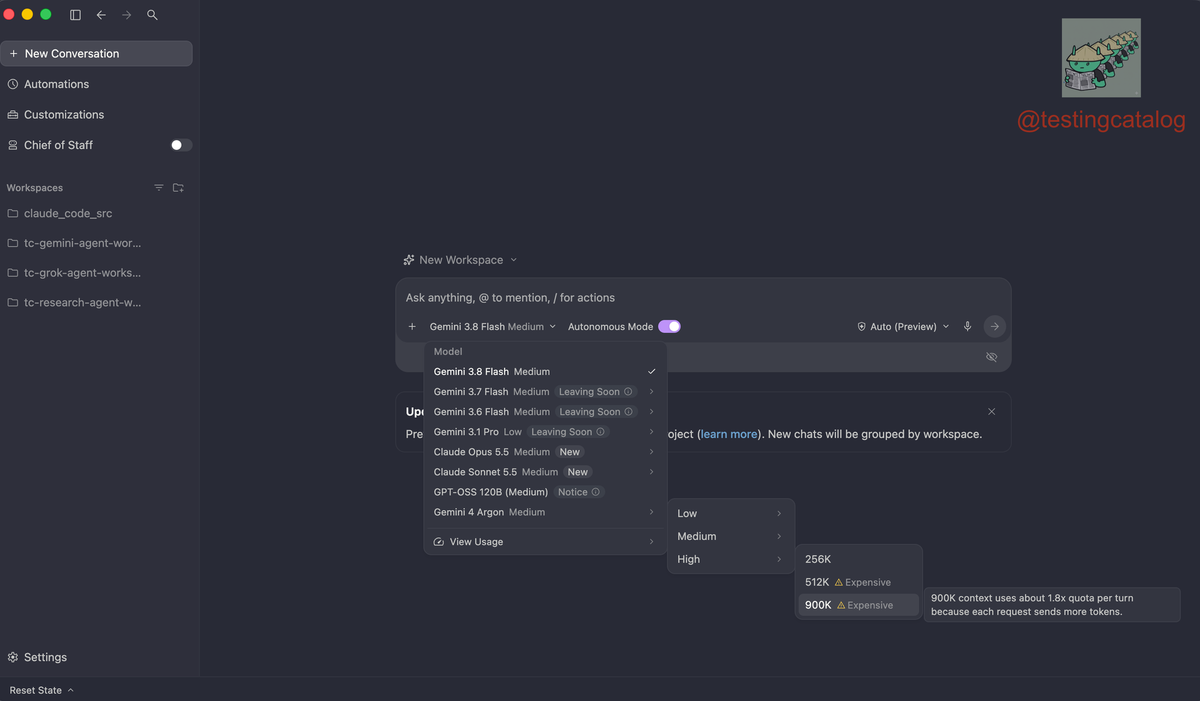
Google is nearing the public release of Gemini 4 Argon, with internal leaks revealing a sophisticated tiered context window system and a powerful new checkpoint named "Carbon." Evidence found in Google’s "Antigravity" internal tool suggests that Argon will offer users the ability to scale context from 256K to 900K tokens, with corresponding increases in quota consumption. Furthermore, internal testing of the "Carbon" iteration indicates that Google may finally have a coding model capable of rivaling or exceeding the performance of Claude 5.5 Opus, specifically within autonomous coding environments.
- Tiered Context Windows: Argon features three configurations: 256K (default), 512K (1.3x quota), and 900K (1.8x quota).
- Carbon Checkpoint: An internal iteration of Gemini 4 that reportedly matches the coding proficiency of Claude 5.5 Opus.
- Thinking Effort Settings: Gemini Web is introducing low, medium, and high "thinking effort" toggles, allowing users to modulate reasoning depth.
- Chief of Staff Agent: A new autonomous agent (formerly Concierge) integrated into the Antigravity platform to facilitate complex task automation.
DO-AI Analysis:
The introduction of "Thinking Effort" toggles and tiered context quotas marks a shift from static inference to "Dynamic Compute Allocation." Architects should view this as a move toward more granular cost-performance optimization; instead of a one-size-fits-all call, developers can now programmatically adjust the reasoning intensity based on the complexity of the sub-task. The "Carbon" checkpoint’s focus on coding suggests that Google is doubling down on the "AI Software Engineer" use case, aiming to turn Gemini into a primary IDE-integrated backbone rather than just a chat interface.
3. OpenAI Clarifies Dismissal of Safety Researchers Amid Policy Violations
The News Highlight:
OpenAI has publicly addressed the departure of three safety researchers—Jasmine, Mikita, and Tomek—stating that their dismissal was the result of a thorough investigation into violations of sensitive-information policies. The company explicitly denied that the terminations were related to the researchers raising safety concerns, a point of contention following a public letter released by the trio. OpenAI used the announcement to reaffirm its commitment to "monitorability" and announced that it is finalizing contracts with third-party safety assessors to provide external oversight of its frontier models.
- Policy Violations: OpenAI cited a "significant breach of trust" regarding the handling of sensitive internal information as the primary cause for dismissal.
- Third-Party Oversight: Contracts with independent safety organizations are nearing completion to embed external assessors into the development lifecycle.
- Monitorability Focus: OpenAI reaffirmed its investment in "Monitoring Monitorability" and open-sourcing evaluation frameworks for models like GPT-6 Astra.
- Internal Culture: The company maintains that spirited safety debates are encouraged and essential to their decision-making process.
DO-AI Analysis:
This incident highlights the growing tension between "Open Research" and "Corporate Security" in the frontier model race. For enterprise architects, the critical takeaway is the formalization of "Monitorability" as a core engineering pillar. As models become more autonomous, the ability to audit and monitor internal states becomes as important as the model's output itself. Organizations should look toward OpenAI’s released "monitorability evals" as a blueprint for building their own internal AI safety and compliance guardrails.
Morning Executive Comparison Matrix
| Dispatch |
Core Domain |
Production Maturity |
DO-AI Recommendation |
| Nvidia / Reflection AI |
AI Infrastructure & Agents |
Emerging / M&A Phase |
Monitor for "Nvidia-Optimized" open-weight model releases. |
| Gemini 4 Argon |
Frontier Models & Coding |
Beta / Internal Testing |
Prepare for dynamic quota management in LLM orchestration layers. |
| OpenAI Safety |
Governance & Compliance |
Operational / Policy-Driven |
Adopt "Monitorability" frameworks for internal AI auditing. |