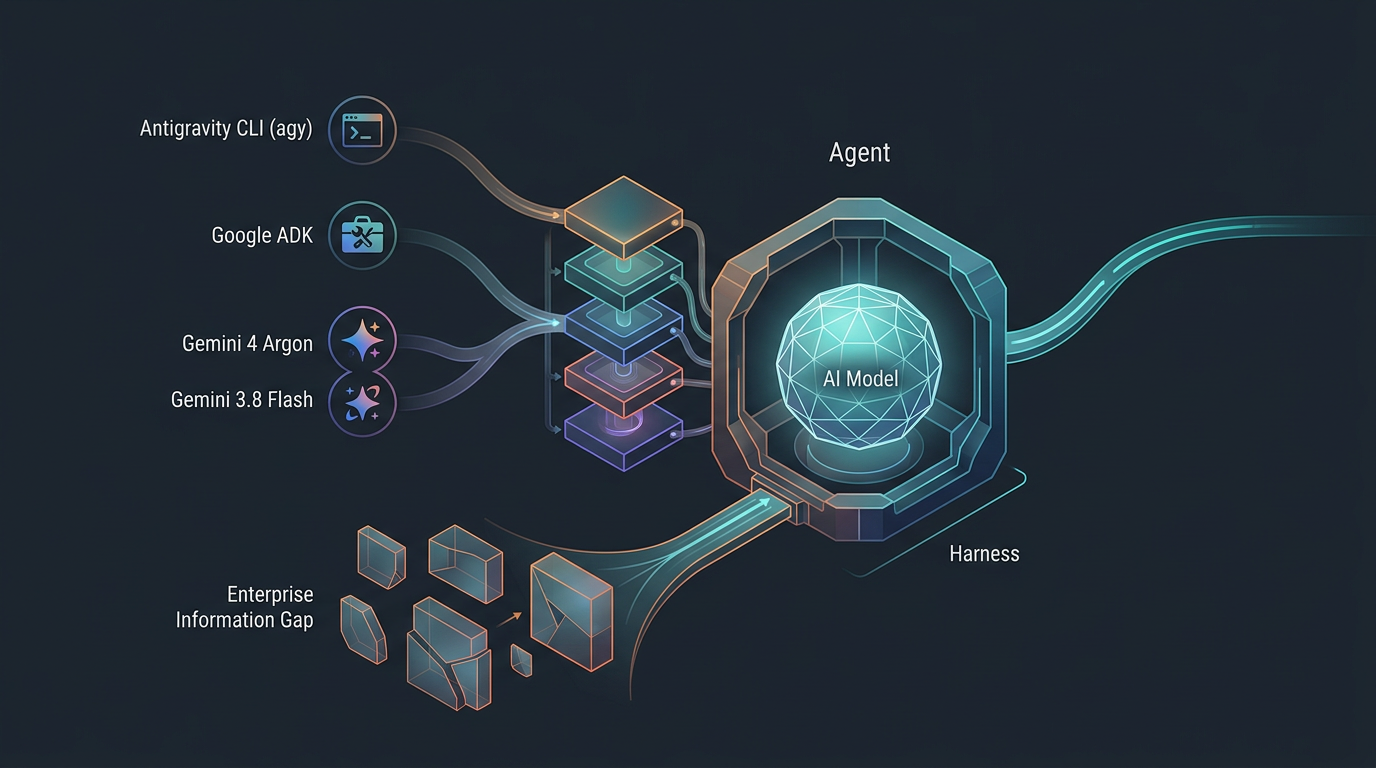
Your AI Model Isn't Dumb, Your Harness Is Broken: How Harness Engineering Bridges the Enterprise Information Gap — How Does It Work in Production?
TL;DR: Upgrading to the latest frontier model will not fix your failing enterprise AI agents if your underlying execution architecture is broken. The root cause of hallucinated code, abandoned refactors, and infinite loops isn't a lack of model intelligence; it is the "enterprise information gap"—the void between a model's stateless token prediction and your system's required structural memory. By shifting from Prompt Engineering to Harness Engineering (Agent = Model + Harness) and implementing a self-verifying architecture with feedforward guides and inferential sensors, engineering teams can transform erratic AI experiments into deterministic, long-running production workhorses.
We have all lived through the exact same cycle of misplaced optimism. A new frontier model drops—perhaps it boasts a massive context window or unprecedented reasoning benchmarks—and we immediately deploy it against our most tangled enterprise codebases. We give it a high-level prompt: "Refactor this legacy payment gateway to use the new microservices architecture."
For the first few minutes, the output looks like magic. The model generates hundreds of lines of syntactically perfect code. But then, the illusion shatters. The agent overwrites a critical security middleware it forgot about. It gets stuck in a loop trying to fix a type error. Or worse, it simply stops halfway through, declaring the job done while leaving the repository in an uncompilable state.
The immediate reflex is to blame the model. We assume it isn't smart enough, so we wait for the next version. But the model isn't dumb. Your harness is broken.
The enterprise information gap is the fundamental disconnect between how Large Language Models operate (as discrete, stateless prediction engines) and how enterprise software is actually built (through continuous, stateful, incremental, and verified progress). Bridging this gap requires a fundamental architectural shift. We must stop treating AI as an omniscient oracle and start treating it as a raw computational engine that requires a meticulously engineered chassis.
Dropping the Chatbot: A Hands-On Evolution
In my recent perspectives study notes and hands-on tutorials exploring the history of AI adoption, I documented the painful but necessary evolution of how we interact with machine intelligence. The journey always begins with the chat interface.
As Mitchell Hashimoto perfectly articulated in his AI Adoption Journey, the first mandatory step to achieving real productivity is to "Drop the Chatbot." Chatbots are incredible for brainstorming, but their utility in complex software engineering is highly limited. You are essentially hoping the model guesses the right answer based on its training data, and when it fails, you are forced into an inefficient loop of manually copying, pasting, and correcting its mistakes.
To find actual value, you must move to an agent—an LLM equipped with a loop that can read files, execute programs, and make HTTP requests. But simply wrapping a while loop around an API call is a recipe for disaster. In my hands-on experiments, I forced myself to reproduce my own manual commits using agentic workflows. I would do the work manually, and then fight an agent to produce identical results. It was excruciating. The friction was immense.
But through that friction, the edges of agentic capabilities became clear. I realized that if you give an agent a vague request and ask it to "draw the owl" in one mega-session, it will fail. However, if you break the session down, separate planning from execution, and—most importantly—give the agent a way to verify its own work, it will consistently fix its own mistakes and prevent regressions. This realization is the genesis of Harness Engineering.
Context Amnesia and the "One-Shot" Trap
To understand why a harness is necessary, we have to understand how agents fail in the wild. As AI agents become more capable, we ask them to take on tasks that span hours or days. But getting an agent to make consistent progress across multiple context windows remains a massive challenge.
Anthropic's engineering research on effective harnesses for long-running agents highlights the core problem: agents work in discrete sessions, and each new session begins with total amnesia. Imagine a software project staffed by engineers working in shifts, where every time a new engineer clocks in, they have absolutely zero memory of what happened on the previous shift.
Even with advanced context compaction, frontier models fall into two predictable failure modes when operating without a proper harness:
- The One-Shot Trap: The agent tries to do too much at once. It attempts to build the entire application in a single pass, runs out of context in the middle of implementation, and leaves the next session to start with half-implemented, undocumented features. The subsequent agent has to guess what happened, wasting massive amounts of compute just trying to get the app back to a working state.
- The Premature Completion Trap: Later in a project, an agent instance looks around, sees that some progress has been made, and incorrectly declares the entire job finished, skipping critical edge cases and testing.
The solution isn't to build a bigger context window. The solution is to enforce state management. Anthropic's breakthrough was decomposing the problem into an Initializer Agent (which sets up the environment, creates a strict feature requirement JSON, and initializes a git repository) and a Coding Agent (which is strictly prompted to make incremental progress on one feature at a time, leaving structured updates in a progress.txt file and committing to git).
This mirrors what effective human engineers do every day: we don't hold the entire codebase in our working memory; we rely on Jira tickets, git histories, and CI/CD pipelines to maintain state.
Agent = Model + Harness
This brings us to the architectural paradigm that defines 2026: Harness Engineering. As Birgitta Böckeler outlines in her seminal piece on the topic, the term "harness" has emerged as the shorthand for everything in an AI agent except the model itself.
Agent = Model + Harness.
Context engineering provides the means to make information available to the agent, but harness engineering is about control. A well-built outer harness serves two goals: it increases the probability that the agent gets it right on the first attempt, and it provides a feedback loop that self-corrects issues before they ever reach human eyes.
This is achieved through two primary mechanisms:
- Feedforward (Guides): Controls that anticipate the agent's behavior and steer it before it acts. This includes strict system prompts, coding conventions, and bootstrap scripts.
- Feedback (Sensors): Controls that observe the agent after it acts and help it self-correct. This is where the magic happens.
Crucially, these sensors come in two execution types:
- Computational Sensors: Deterministic, fast, and run by the CPU. These are your linters, type checkers, and structural tests (like ArchUnit). They run in milliseconds and provide reliable, hard boundaries.
- Inferential Sensors: Semantic analysis, AI code review, and "LLM-as-a-judge." These are run by GPUs/NPUs. They are slower and more expensive, but they allow us to provide rich, semantic judgment that a linter could never catch.
If you only have feedforward guides, you have an agent that encodes rules but never finds out if they worked. If you only have feedback sensors, you have an agent that blindly guesses and constantly hits walls. You need both, orchestrated in a continuous steering loop that keeps quality as far left in the development lifecycle as possible.
The 6-Layer Harness Architecture in Production
So, how do we actually build this in production today? We leverage specialized models for specialized tasks within a structured orchestration layer.
Here in 2026, the release of Gemini 4 Argon in Google Antigravity has provided us with a frontier model capable of incredible heavy lifting, reasoning through complex physics simulators and tracing runtime security flaws. But using Argon for every single step of a loop is financially ruinous and architecturally lazy. Instead, we pair it with Gemini 3.8 Flash, which serves as our high-speed, low-cost inferential sensor.
A production-grade, self-verifying harness consists of 6 distinct layers:
- The Initializer Layer: A specialized prompt run once at the start of a task. It maps the repository, generates a strict
progress.json file detailing the required steps, and establishes the baseline git state.
- The Feedforward Layer: Injects ambient affordances—coding standards, API documentation, and the current state of
progress.json—into the context before execution.
- The Execution Engine: The heavy lifter (e.g., Gemini 4 Argon or Gemini 2.5 Pro) tasked with implementing exactly one incremental step.
- The Computational Sensor Layer: Fast, deterministic CPU checks. Did the code compile? Did the unit tests pass? Did the linter flag syntax errors? If this fails, the error is fed directly back to the Execution Engine.
- The Inferential Sensor Layer: The semantic judge (e.g., Gemini 3.8 Flash or Gemini 2.5 Flash). It reviews the diff against the original requirement. Did the Execution Engine actually solve the problem, or did it just write a mock that passes the test?
- The State Committer: If both sensors pass, the harness commits the code to git, updates
progress.json, and loops back to layer 2 for the next feature.
flowchart LR
    subgraph Layer1Initialization["Layer 1: Initialization"]
    A[Initializer Agent] --> B[(progress.json & Git Init)]
    end

    subgraph Layer23Execution["Layer 2 & 3: Execution"]
    B --> C[Feedforward Guides]
    C --> D[Execution Engine<br/>Gemini 4 Argon / 2.5 Pro]
    end

    subgraph Layer45Verification["Layer 4 & 5: Verification"]
    D --> E{Computational<br/>Sensors}
    E -- Fails --> D
    E -- Passes --> F{Inferential<br/>Sensors<br/>Gemini 3.8 Flash}
    F -- Fails --> D
    end

    subgraph Layer6StateManagement["Layer 6: State Management"]
    F -- Passes --> G[State Committer<br/>Git Commit]
    G --> B
    end

    style A fill:#f9f,stroke:#333,stroke-width:2px
    style D fill:#bbf,stroke:#333,stroke-width:2px
    style F fill:#bfb,stroke:#333,stroke-width:2px
Production Implementation: The Antigravity ADK
To make this concrete, here is how you implement this 6-layer harness using the Google ADK and Antigravity CLI concepts. Notice how we explicitly separate the heavy execution model from the fast inferential judge, and how state is rigidly managed.
import json
import subprocess
from google_adk import AntigravityClient, ModelConfig

# Initialize the Antigravity client with our dual-model strategy
client = AntigravityClient()
coder_model = ModelConfig(model_name="gemini-4-argon", temperature=0.2)
judge_model = ModelConfig(model_name="gemini-3.8-flash", temperature=0.0)

def run_computational_sensors():
    """Layer 4: Fast, deterministic CPU checks."""
    result = subprocess.run(["npm", "run", "test"], capture_output=True, text=True)
    return result.returncode == 0, result.stdout

def run_inferential_sensors(diff, requirement):
    """Layer 5: Semantic AI judge using fast Flash model."""
    prompt = f"""
    You are a strict code reviewer. Review this git diff against the requirement.
    Requirement: {requirement}
    Diff: {diff}
    Did the code fully implement the requirement without introducing regressions or taking shortcuts?
    Respond ONLY with a JSON object: {{"pass": true/false, "feedback": "reason"}}
    """
    response = client.generate(model=judge_model, prompt=prompt)
    return json.loads(response.text)

def harness_execution_loop(task_id):
    """The core steering loop."""
    # Layer 1: Load state
    with open("progress.json", "r") as f:
        state = json.load(f)

    current_task = state["tasks"][task_id]

    retry_count = 0
    max_retries = 3

    while retry_count < max_retries:
        # Layer 2 & 3: Feedforward & Execution
        feedforward_context = f"Current task: {current_task['description']}. Follow project linting rules."
        code_patch = client.generate_code(
            model=coder_model,
            context=feedforward_context,
            workspace_path="./src"
        )

        # Apply patch to workspace
        client.apply_patch(code_patch)

        # Layer 4: Computational Sensor
        comp_pass, comp_logs = run_computational_sensors()
        if not comp_pass:
            client.revert_workspace()
            feedforward_context += f"\nPrevious attempt failed tests: {comp_logs}"
            retry_count += 1
            continue

        # Layer 5: Inferential Sensor
        git_diff = client.get_workspace_diff()
        inf_result = run_inferential_sensors(git_diff, current_task['description'])

        if not inf_result["pass"]:
            client.revert_workspace()
            feedforward_context += f"\nPrevious attempt failed review: {inf_result['feedback']}"
            retry_count += 1
            continue

        # Layer 6: State Committer
        client.commit_workspace(message=f"feat: {current_task['name']}")
        current_task["status"] = "completed"

        with open("progress.json", "w") as f:
            json.dump(state, f, indent=2)

        print(f"Task {task_id} successfully harnessed and committed.")
        return True

    print(f"Task {task_id} failed after {max_retries} attempts. Human intervention required.")
    return False
Real-World Use Cases: Where This Moves the Needle in the Field
The theory of Harness Engineering is elegant, but its true value is proven in the trenches. When we deploy this architecture across enterprise environments, the results are transformative. Here are three concrete field scenarios demonstrating how this bridges the information gap.
1. Legacy & Codebase Migrations (The Fortran to Rust Rewrite)
- The Everyday Problem: Vital scientific research or core banking logic is locked inside fragile, decades-old legacy codebases (like Fortran or COBOL). Human engineers are terrified to touch it because the original authors are gone, and there are no unit tests.
- How It Works in Practice: Using a custom skill within Antigravity, the Initializer Agent maps the entire legacy codebase and generates a massive
progress.json file detailing every function that needs translation. The Execution Engine (Argon) rewrites one function at a time into modern Rust. The Computational Sensor runs the Rust compiler to ensure memory safety, while the Inferential Sensor (Flash) compares the mathematical output of the new Rust binary against the old Fortran binary for the exact same inputs.
- The Tangible Impact: As noted by the Antigravity team, this autonomous harness delivered a modernized codebase achieving a 1.8x performance boost and guaranteed memory safety, without requiring a multi-year human rewrite initiative.
2. Technical Debt & Automated Backlog Burndown
- The Everyday Problem: Engineering teams are drowning in stale bug queues. Hundreds of Jira tickets sit unassigned because no one has the time to investigate if the bug is still reproducible, if it was fixed by a tangential commit, or if it's a duplicate.
- How It Works in Practice: We deploy "End-of-Day Agents" (a concept championed by Mitchell Hashimoto). The Initializer grabs the queue of open bug reports. For each ticket, the Execution Engine cross-references commit histories and live telemetry. The Inferential Sensor acts as a judge, determining if the error still occurs in production logs. If the bug is dead, the State Committer closes the ticket with documented commit proof.
- The Tangible Impact: In a recent internal Google deployment, an Argon-powered harness took an aging queue of 134 open bug reports and, in under 3 hours, autonomously closed 97 stale or duplicate bugs (a 72.4% queue reduction), sorting the remaining 37 by owner.
3. Security Audits & Runtime Tracing
- The Everyday Problem: Standard static code analysis and basic LLM diff-reviews miss complex, multi-service security vulnerabilities. A standard agent looking at a pull request only sees the changed lines, not how permissions flow through the entire system at runtime.
- How It Works in Practice: The harness is configured to run post-integration. The Feedforward layer injects the entire runtime architecture context. Instead of just reading the code diff, the Execution Engine traces how permissions actually flow at runtime. The Inferential Sensor is prompted specifically with OWASP top 10 heuristics to judge the execution trace.
- The Tangible Impact: Two earlier frontier models audited an identical batch of access-control changes and concluded there were zero security holes. The Argon-powered harness, utilizing runtime tracing and inferential sensors, found four critical security bugs before they reached production.
📊 Production FinOps & TCO Simulation
A common objection from engineering leadership is that building a 6-layer harness with continuous inferential sensors will explode cloud costs. "Why run three API calls when one prompt should do the trick?"
The reality is the exact opposite. The "Naive One-Shot" approach results in massive token waste because the expensive frontier model constantly hallucinates, loses context, and requires full human-initiated retries. By offloading the continuous feedback loops to a highly efficient model like Gemini 2.5 Flash, the harness drastically reduces the retry rate of the expensive execution model.
Here is the deterministic FinOps breakdown comparing a naive approach versus a properly engineered harness for an enterprise processing 10,000 complex coding tasks a month.
Based on the latest Google SKU information
| Architecture Option |
Google SKU Unit Price & Monthly Formula |
Estimated Monthly Cost |
| Naive One-Shot Agent (High Retry Rate) |
Gemini 2.5 Pro Input (Naive Retries): $1.25/1M input tokens × 15,000 = $18,750.00
Gemini 2.5 Pro Output (Naive Retries): $10/1M output tokens × 1,500 = $15,000.00 |
$33,750.00 / mo |
| 6-Layer Harness (Flash Sensors + Pro Coder) |
Gemini 2.5 Pro Input (Initializer & Coder): $1.25/1M input tokens × 5,500 = $6,875.00
Gemini 2.5 Pro Output (Initializer & Coder): $10/1M output tokens × 550 = $5,500.00
Gemini 2.5 Flash Input (Inferential Sensors): $0.15/1M input tokens × 20,000 = $3,000.00
Gemini 2.5 Flash Output (Inferential Sensors): $0.6/1M output tokens × 2,000 = $1,200.00
Cloud Run vCPU (Harness Orchestration): $2.4e-05/vCPU-second × 2,592,000 = $62.21
Cloud Run Memory (Harness Orchestration): $2.5e-06/GiB-second × 5,184,000 = $12.96 |
$16,650.17 / mo |
| Net FinOps Impact (Monthly Savings) |
Based on the latest Google Cloud pricing |
50.7% TCO Reduction ($17,099.83 / mo) |
By engineering the harness, you aren't just improving code quality and reducing developer toil; you are cutting your generative AI infrastructure costs in half. You stop paying a genius model to blindly guess, and start paying a system to deterministically verify.
The era of Prompt Engineering is over. The era of Context Engineering is maturing. The future of enterprise AI belongs entirely to Harness Engineering. Your model isn't dumb. It's just waiting for you to build the chassis it deserves.